From BSM to EFT: Feynman Rules and Universal Feynman Output (UFO)
Since Matchete can automatically match BSM theories onto their EFT descriptions at low energies and allows for the derivation of Feynman rules as well as the export of Universal Feynman Output (UFO) files, it is ideally suited for preparing EFT validity studies, as showcased in a specific example below.
Example: UFO for the 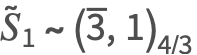 leptoquark and its EFT
As an example, the  leptoquark is considered here. In the following, the model definition, the matching, the electroweak symmetry breaking, the derivation of Feynman rules, and the generation of UFO files is discussed. The most important functions for this purpose are:
leptoquark is considered here. In the following, the model definition, the matching, the electroweak symmetry breaking, the derivation of Feynman rules, and the generation of UFO files is discussed. The most important functions for this purpose are:| FeynmanRules[lag] | computes all Feynman rules from the given Lagrangian lag. |
| ExportUFO[lag] | exports the UFO files with all Feynman rules derived from the given Lagrangian lag. |
| DefaultParamCard[lag] | generates a default parameter card for the given Lagrangian lag, which serves as input to ExportUFO. This template exploits all information available to Matchete about the couplings of the theory in order to provide a minimal parametrization. However, it only serves as a starting point and should be modified afterwards, e.g., by specifying the numerical input for all parameters. |
| DefineCouplingOrder[label,couplings, hierarchy] | defines a new coupling order for the UFO format. Its label must be a string, and coupling must be a coupling label or list of coupling labels (possibly including powers) of the couplings that should be assigned this order. The relative hierarchy with respect to other coupling order can be set through hierarchy. |
| ImposeFlavorSymmetry[lag, sym] | takes a flavor symmetry (sym), given by the representations of the fields, and computes the invariant flavor structures and assigns them to the couplings in a Lagrangian (lag). The returned association of flavor structures can then be given to DefaultParamCard and ExportUFO through the option FlavorInvariants to parametrize the coupling. |
As a first step, the Matchete package is loaded into the kernel:

Standard Model
The stating point for defining a BSM theory is the Standard Model (SM) Lagrangian, which can be loaded using:
This returns the Lagrangian in the unbroken electroweak phase, but all definitions required for the symmetry breaking are set up already in the background.
 leptoquark model
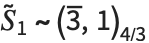 leptoquark, can be defined in the unbroken phase by:
SSB relations for the BSM components
The SSB relations for the SM are already set up when loading the "SM+breaking" model file. The BSM relations can be provided as follows.
Note that this field has electric charge 4/3 rather than Hypercharge. In addition, auxiliary information required for generating UFO files is included through the option UFO. The only required argument is "pdg" which provides the PDG code for the particle. The additional arguments are not mandatory, but allow to control the names used in the UFO files. However, since we use the same symbol for the broken an unbroken phase mass term, we also need to ensure the related auxiliary information agrees between the two calls of DefineField above.
The field decomposition, i.e., the relation between 1t and S1t, can be provided through the routine FieldDecomposition:
 is a
is a  singlet, this is a trivial one-to-one relation.
The full Lagrangian of this BSM theory in the vacuum of the broken phase is then derived using ToBrokenPhase and ImplementVacuumConditions:
where the option SubstituteMasses -> True is used to ensure that the canonical mass couplings are substituted into the Lagrangian for the broken phase fields.
One can then use the Lagrangian ℒBSMbroken to derive the Feynman rules and to generate the UFO files.
Matching
If one is also interested in obtaining the UFO for the corresponding EFT of this BSM theory, one can match the leptoquark Lagrangian onto the SMEFT. This matching has to be performed in the unbroken electroweak phase:
Note that this operator is not in the Warsaw basis and contains charge conjugation matrices, which can be problematic when using the UFO files in MadGraph. Therefore, we can use 4-dimensional Fierz identities to bring it into the form of a Warsaw basis operator:
EFT in the broken phase
The EFT Lagrangian after electroweak symmetry breaking can then be determined as before since no additional information about the SSB patterns is required in this case:
Before generating the UFO files for the BSM and the EFT Lagrangians one can investigate the corresponding Feynman rules using the FeynmanRules routine.
Feynman rules of the BSM theory

Here, we only show the Feynman rules involving the  . The objects printed in gray brackets represent the external fields, i.e, for fermion they are spinors, for vectors they are polarization vectors, and for scalars they are simply unity. The subscripts provide a numbering for the various external fields in every vertex. The warning message is printed since the Lagrangian ℒ1tbroken does not contain the kinetic terms for the gluon and photon and thus Matchete cannot determine the normalization of the QCD and QED gauge couplings, instead it simply assumes the default normalization. If the full BSM Lagrangian ℒBSMbroken is used this message is not shown.
. The objects printed in gray brackets represent the external fields, i.e, for fermion they are spinors, for vectors they are polarization vectors, and for scalars they are simply unity. The subscripts provide a numbering for the various external fields in every vertex. The warning message is printed since the Lagrangian ℒ1tbroken does not contain the kinetic terms for the gluon and photon and thus Matchete cannot determine the normalization of the QCD and QED gauge couplings, instead it simply assumes the default normalization. If the full BSM Lagrangian ℒBSMbroken is used this message is not shown.Feynman rules of the EFT
Here, we only show the rule for the higher-dimensional vertex for brevity. And we use Conj (this can also be replaced by Bar) do denote the conjugate external states.
Before generating the UFO files one can perform additional operations. For simplicity, we set the CKM matrix to the identity:
Defining coupling orders
It is useful to define coupling orders for the UFO files to control which interaction should be considered in simulations. To that end, three different coupling orders ("QED", "QCD", and "NP") are defined below using DefineCouplingOrder:
Here, λ is order 2 in "QED" while v is order -1 (the order is the inverse of the exponent provided above). Moreover, two insertions of the QCD coupling gs should be counted as the same size as one QED coupling, whereas the NP coupling is assigned the hierarchy 99 to only consider diagrams with at least one BSM coupling by default.
Parameter cards
The next step is to write parameter cards (in JSON format) for the UFO generation, which provide a parametrization and numerical values for all parameters in the Lagrangian. Templates for these parameter cards can be generated with the DefaultParamCard routine:

This generates a JSON file named "model_parameters.json" in the directory given by DirectoryBSM. The option DefaultValuesTrue indicates that default numerical input values for the SM parameters should be included and Matchete attempts to assign these automatically to the correct parameters of the model. The assignment is printed as well. Note that this feature is only intended as help for fairly simple models as considered here. It might not work in more complicated scenarios.
As indicated, the Lagrangian is automatically fixed to Feynman gauge. Alternative options can be chosen using the Gauge and Rξ options.
In any case, the generated parameter card should be checked and potentially edited manually, e.g., using:

Matchete also informs the user that the leptoquark mass parameter M1St is not given the default value '0' but '1' to avoid divergent coefficients.
Flavor symmetries
Alternatively, one can also apply flavor symmetries to further reduce the number of free parameters in the BSM theory and its corresponding EFT. This is achieved calling the function ImposeFlavorSymmetry. For example, assuming a U(2)5 flavor symmetry acting on the five types of chiral SM fermions, one can first define the corresponding global symmetry groups:
Note that one has to identify U(2)~SU(2)U(1) since Matchet only allows to define simple groups. The flavor symmetry can then be assigned to the chiral fields in terms of an association, where for every flavor its representations are specified:
Note that since no representation was specified for the third generation it is automatically assumed to be a Singlet (equivalently, one can also explicitly include {3}->Singlet for all fermions. At most one non-Abelian representation is allowed per flavor, while an arbitrary number of U(1) charges can be given.
which determines for all flavored couplings present in the Lagrangian ℒBSM the invariants under the flavor groups and associates these to the couplings in form of SparseArrays, which are returned in the form of an association.
Note that ImposeFlavorSymmetry requires the Lagrangian ℒBSM in the unbroken electroweak phase as input, since the flavor symmetry is defined on the level of the chiral fields. In addition, it requires the coupling indices to be directly contracted with the fields and not with other couplings.
Note that only one invariant is found for the coupling κ here and no flavor structures are determined for the Yukawas (meaning that they remain in their most general form) since we used the option Except->{Yu,Yd,Ye} above. In the present case, the flavor invariants for the Yukawa are anyways irrelevant since the Yukawas have been replaced by the fermion masses in the broken phase.
The flavor invariants are then used to parametrize the couplings of the theory when calling DefaultParamCard afterwards with the option FlavorInvariants:

This produces the same parameter card as before, but all couplings forbidden by the symmetry are removed (i.e. their value is set to "ZERO" which will remove them entirely from the UFO files once ExportUFO is called), while the invariant structures are parametrized in a minimal way. The parameter card can again be inspected and modified using:
"Kappa_11":{
"name":"Kappa_11",
"nature":"internal",
"type":"real",
"value":"ZERO",
"texname":"Kappa_11"
}
where "value":"ZERO" indicates that parameter "Kappa_11", which is forbidden by the flavor symmetry, should be entirely dropped from the UFO.
Exporting UFO files
The UFO files can now be generated using the ExportUFO function:
Here, OutputDirectory determines where the UFO files are saved and InputFile should point to the parameter card generated before. If no InputFile is specified, the default parameter card will be used and a UI will open that allows to manually edit the parameters and inputs. In this later case, one can also use the option FlavorInvariants, as above for the call of DefaultParamCard, to provide flavor invariants if desired.
Note that the gauge is again fixed to Feynman gauge. When using other options, one has to ensure that the choices for DefaultParamCard and ExportUFO agree. An efficient way to do so is by using the function GaugeFixLagrangian before calling either of these routines.